
When a business launches a website, corporate email and starts operating across multiple languages or markets, the challenge is usually not a single domain or a single mailbox. The real task is making sure everything works together as one consistent system. That was exactly the goal in this project for AA ENERGOBUD.
The work required combining domains, Google Workspace corporate email, DNS records, hosting and a future multilingual WordPress website into one clear structure. One domain was meant to serve as the base for corporate email and the English version of the website, while the other was intended for the Polish version. In practice, this meant more than simply connecting another domain. It required building a technical foundation that would work reliably from the start and would not need to be rebuilt after launch.
Initial situation
At the beginning of the project, there were two domains registered with OVH (See our article “How to choose a domain registrar”). Google Workspace was already in use for the main domain: the primary corporate mailbox had been created, additional addresses had been configured, and basic domain verification had been completed.
The next step was to connect the second domain so that it would work correctly both for email logic and for the Polish language version of the website. At the same time, one WordPress installation had to be prepared to operate across two domains through WPML: the English version on .com and the Polish version on .pl.
This was no longer just an email setup or a website setup on its own. It was an infrastructure task where email, domains, DNS, hosting and SEO directly affected one another.
What had to be solved
The project required connecting the second domain as an alias domain in Google Workspace, preserving correct operation of corporate addresses across both domains, reviewing and correcting DNS records, preparing core email authentication through SPF, DKIM and DMARC, adding the second domain in cPanel to a shared document root, preparing one WordPress installation for multilingual operation across two domains, and building the right technical base for further SEO work.
Where the real complexity came from
At first glance, tasks like this can seem straightforward: add a domain, connect email, point the website. In practice, the biggest issues appear where several systems meet.
If the second domain is added without aligning it with the email logic, some messages may stop reaching inboxes or may work inconsistently. If cPanel starts handling mail locally instead of passing it to Google Workspace, routing problems appear. If a multilingual website on two domains is configured without a clear structure, duplicate pages, indexing issues and unnecessary SEO risks follow.
In other words, the task was not simply to connect everything, but to make sure domains, email and the website worked together in a coordinated way.
What was done
Domain and DNS audit
The work started with reviewing the DNS zones of both domains. It was necessary to clearly separate the records responsible for the website from those responsible for email, and to identify whether mixed settings from different services were present.
At this stage, the core logic was defined: both domains had to point to the website, while email had to remain under Google Workspace rather than under local hosting.
Google Workspace review and second domain connection
The active Google Workspace configuration for the main domain was confirmed. Then the second domain was prepared as an alias domain so that email addresses on it would work within the same corporate structure.
This made it possible to avoid unnecessary separate accounts in situations where properly configured aliases and the right domain logic were enough. For the business, this means simpler administration, a clearer email structure and lower unnecessary costs.
SPF correction and email logic review
SPF records were reviewed separately. This is one of those areas where an issue may not be obvious at the beginning, but later shows up through poor deliverability or messages landing in spam.
The sending logic was aligned so that the domains worked within one corporate email model without conflicting with one another.
DKIM and DMARC preparation
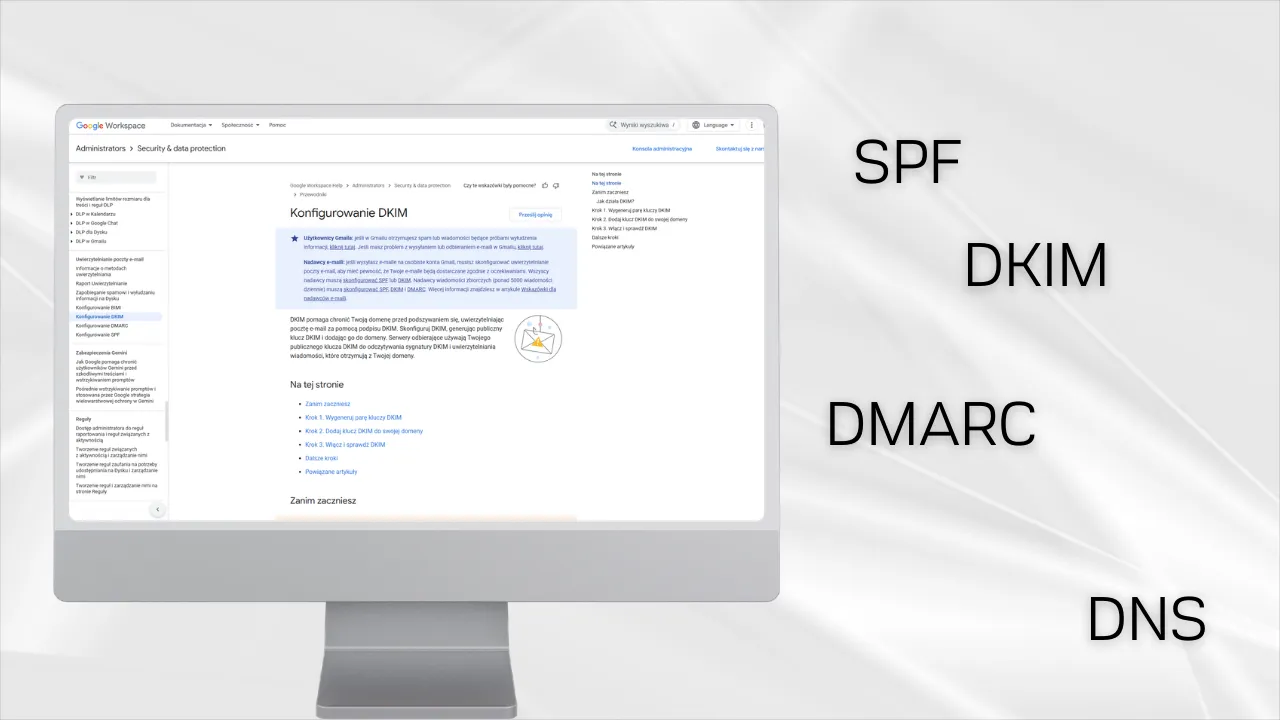
After that, email authentication was prepared at the DKIM and DMARC level. This matters not only for technical email delivery, but also for domain trust, stable corporate email operation and correct sending of messages from the website.
In practice, these are often the factors that determine whether a message appears trustworthy to email providers or is treated as suspicious.
Adding the second domain in cPanel
To avoid creating two separate websites, the second domain was added in cPanel to a shared document root. This means both domains physically serve one WordPress installation.
For the business, this is more convenient and more efficient: one management system, one set of templates and plugins, simpler maintenance and less risk of technical divergence between language versions.
Preparing WordPress and WPML for two domains
At the WordPress level, a model was prepared in which one installation serves two language versions through WPML. The English version was assigned to one domain, and the Polish version to the other.
This is an important point because the right language structure from the start makes it much easier to grow the website later without going back to rebuild the core architecture.
Reviewing the basic SEO logic
Because different domains for different languages directly affect indexing, SEO logic was also taken into account. The goal was to avoid duplicate pages, canonical issues and unclear language targeting.
As a result, the structure was prepared in a way that supports future growth without creating technical debt from the beginning.
What risks were reduced
One of the biggest risks in projects like this is when the second domain is connected to the website but is not aligned with the real email logic. In that case, email can work only partially or behave inconsistently.
Another common risk is a conflict between Google Workspace and local hosting email. If this is not controlled, some messages may be processed in the wrong place.
Separate attention was also given to risks related to SPF, DKIM and DMARC, as well as to multilingual operation across different domains. These are exactly the areas where issues are often created before they become visible after launch.
What was especially important
In this project, it was important not to split the work into disconnected small settings. Email, domains, hosting and WordPress were directly linked to one another.
It was equally important to keep one WordPress installation instead of creating two separate websites. This simplifies maintenance, reduces technical overhead and creates a more stable long-term model.
It was also essential to assign clear roles to the domains: one as the base for the English version and corporate email, the other as the domain for the Polish version of the website. This kind of structure creates an organised foundation both for the business and for SEO.
Result
As a result, for an international construction company, the work produced not a collection of separate settings but one coherent technical model. One WordPress installation now supports two language versions, two domains serve different roles within one project, corporate email keeps a centralised logic, and email authentication is prepared for reliable message delivery.
For the business, this means greater predictability, fewer technical risks and a solid foundation for launching the website, communicating with clients and scaling further.
What the client received in the end
In the end, the client received a clear and scalable system where the website, domains and email do not work against one another. A foundation was created for a multilingual WordPress website, centralised corporate email and further technical development without having to rebuild everything after launch.
The value of this project was not only in the settings themselves, but in the fact that every decision was made as part of one logical structure suitable for stable future operation.
In this case study, the task was not simply to connect another domain or configure a few email addresses. The goal was to build one working foundation where email, domains, hosting and the website support one another instead of creating additional points of risk.
That is exactly the kind of approach that allows a business to start not with a temporary workaround, but with a properly prepared technical base.
Do you need to connect domains, corporate email and a website into one working system? Contact us. We can help prepare the technical foundation without unnecessary rework later.